Status & Rights
Read the United Nations system, and see where P.R.I.D.E. stands within it — an NGO in Special Consultative Status under the Economic and Social Council’s Committee on NGOs.
An overview of the United Nations system
The United Nations system spans several tiers — principal organs, funds and programmes, and specialized agencies. Non-governmental organizations establish a consultative relationship with the UN through the Economic and Social Council (ECOSOC), vetted by its Committee on Non-Governmental Organizations. It was through this mechanism that P.R.I.D.E. was granted ECOSOC Special Consultative Status in 1999.
 United Nations
 Principal Organs
- GA General Assembly
- SC Security Council
- ECOSOC Economic and Social Council
- ICJ International Court of Justice
- ST Secretariat
- TC Trusteeship Council
The Trusteeship Council suspended operation in 1994 after completing its mandate.
Under ECOSOC
ECOSOC builds and manages its consultative relationship with NGOs through its subsidiary committees.
Functional Commissions
- Commission on the Status of Women CSW
- Commission for Social Development CSocD
- Commission on Population and Development CPD
- Commission on Narcotic Drugs CND
Regional Commissions
- Economic and Social Commission for Asia and the Pacific ESCAP
- Economic Commission for Africa ECA
- Economic Commission for Europe ECE
- Economic Commission for Latin America and the Caribbean ECLAC
Other Bodies
- Committee on Non-Governmental Organizations P.R.I.D.E. ▸
- Committee for Development Policy CDP
- Permanent Forum on Indigenous Issues UNPFII
Rest of the UN system
Funds & Programmes
- UNDP UN Development Programme
- UNICEF UN Children’s Fund
- UNFPA UN Population Fund
- UNEP UN Environment Programme
- WFP World Food Programme
- UNHCR UN Refugee Agency
- UN-Habitat UN Human Settlements Programme
Specialized Agencies
- WHO World Health Organization
- UNESCO UN Educational, Scientific and Cultural Organization
- FAO Food and Agriculture Organization
- ILO International Labour Organization
- IMF International Monetary Fund
- World Bank World Bank Group
- WIPO World Intellectual Property Organization
- UNIDO UN Industrial Development Organization
Schematic; representative bodies relevant to our work are shown. See the official UN chart for the full structure.
Where P.R.I.D.E. sits in the UN system
- United Nations
- ECOSOC Economic and Social Council
- Committee on NGOs
- P.R.I.D.E. (Special Consultative Status · 1999)
Vetted by the Committee on NGOs and decided by ECOSOC, P.R.I.D.E. has held Special Consultative Status since 1999.
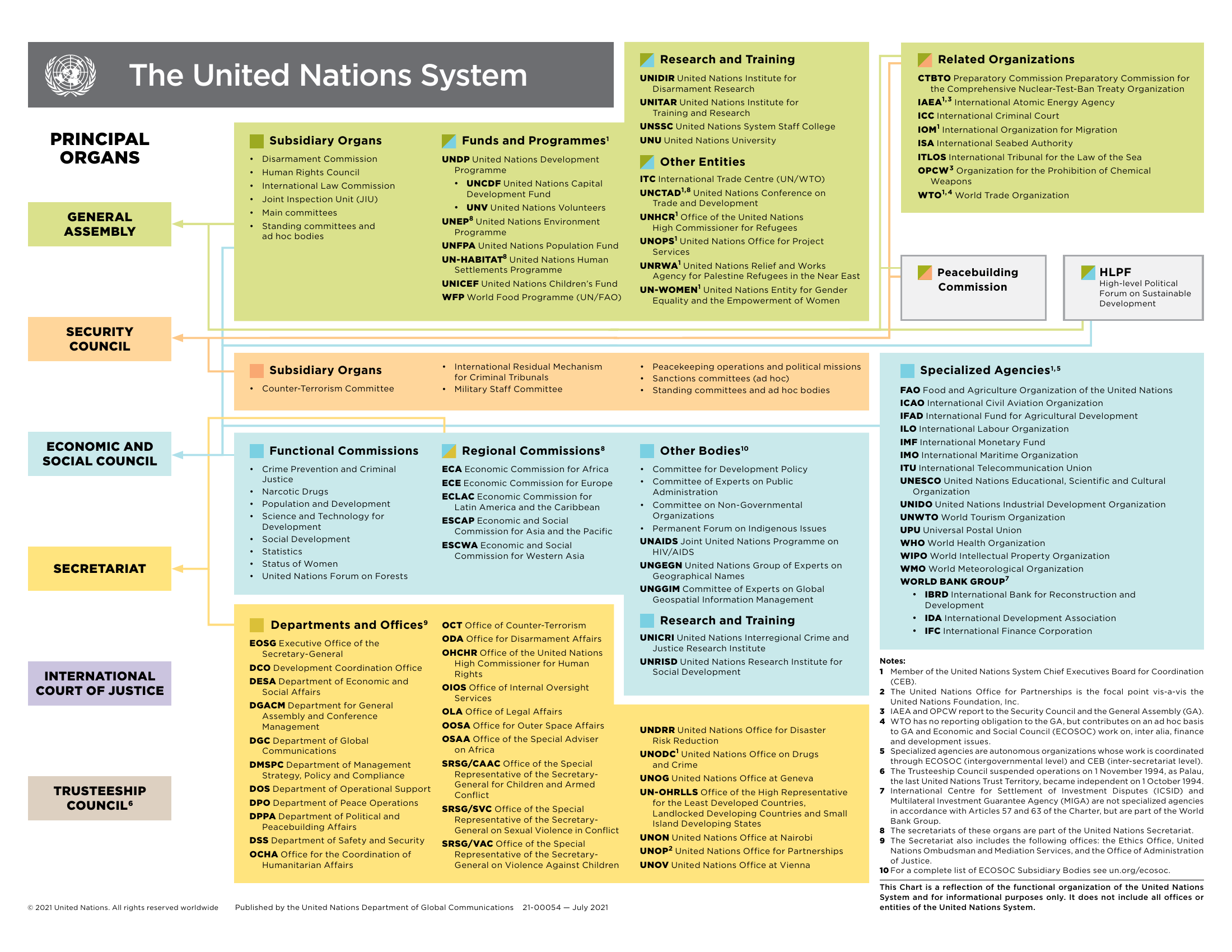
The official UN system chart
Below is the complete system chart published by the United Nations; click to enlarge. The “Committee on Non-Governmental Organizations” under ECOSOC is where our consultative status belongs.
 Click to enlarge ↗
 Rights under Special Consultative Status
Under ECOSOC resolution 1996/31, NGOs in consultative status enjoy a range of participation rights. P.R.I.D.E. holds Special Consultative Status, and may:
- 01
Attend as observers
Designate authorized representatives to sit as observers at public meetings of ECOSOC and its functional commissions (with representatives at UN offices in New York, Geneva and Vienna).
- 02
Receive the agenda
Receive the provisional agenda of meetings of ECOSOC and its subsidiary bodies.
- 03
Submit written statements
Submit written statements on subjects of special competence, circulated by the UN Secretary-General to member States (special status: up to 500 words to the Council, 1,500 words to commissions).
- 04
Make oral interventions
May be heard by ECOSOC’s functional commissions (such as the Commission on the Status of Women, CSW) on matters within its competence.
- 05
Attend UN conferences
Be accredited to attend international conferences convened by the UN and their preparatory meetings, and make brief oral and written presentations.