

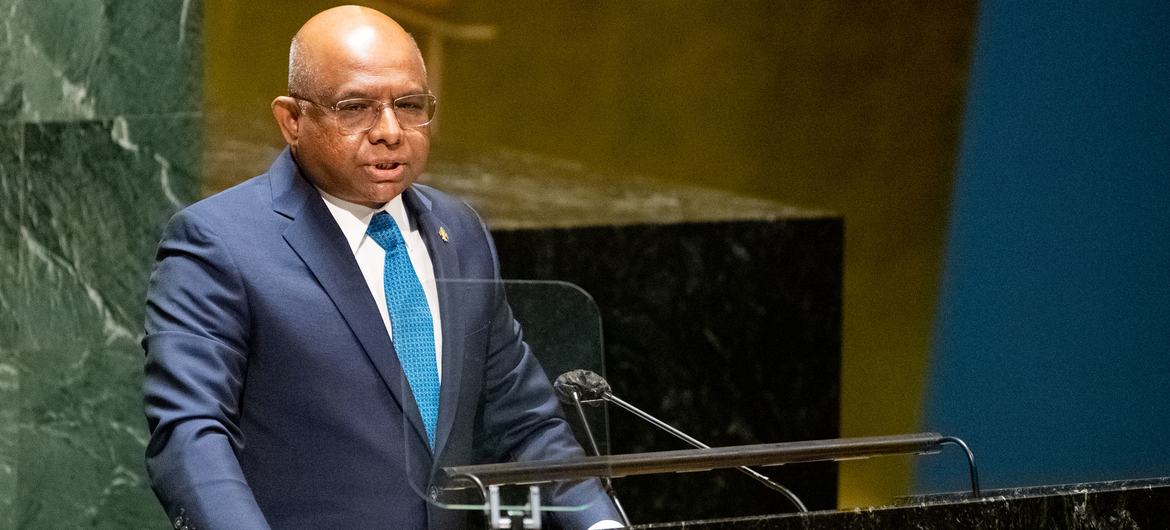
In his opening remarks, Abdulla Shahid, President of the 11th Emergency Special Session of the UN General Assembly, reaffirmed that Russia's military offensive had violated the territorial integrity and sovereignty of Ukraine and was inconsistent with the Charter of the United Nations. He again called for an immediate ceasefire, maximum restraint by all parties, and the full restoration of diplomacy and dialogue.
He pointed out that the convening of the 11th Emergency Special Session of the General Assembly was rooted in the Charter and in the mandate of General Assembly resolution 377 A(V) entitled "Uniting for Peace": "This session brings new hope of ensuring that the United Nations' leadership on matters of peace and security lives up to the expectations of the people we serve."
Shahid noted that in April 1946 the League of Nations was dissolved, ending the 26-year existence of that organization, which ultimately proved unable to prevent the outbreak of the most destructive war in human history.
He said: "The League of Nations' failure to provide a mechanism for enforcing international collective security exposed its most fatal flaw."
In his final "eulogy" for the League of Nations, the Right Honorable Viscount Robert Cecil, one of the founders of the League of Nations, said: "The League is dead. Long live the United Nations."
Shahid said: "Today is the 76th year since the founding of the United Nations. Let us remind ourselves that we founded the United Nations to maintain international peace and security, and to that end to take effective collective measures to prevent and remove threats to the peace, and to bring about by peaceful means, and in conformity with the principles of justice and international law, the adjustment or settlement of international disputes or situations."
"With yesterday's meeting of the Security Council, a rare window of opportunity for dialogue has opened. Let us use this opportunity to de-escalate the situation (in Ukraine) meaningfully and swiftly."
Vote Expected on Wednesday
Because a large number of countries have requested to speak at the emergency special session, the meeting is expected to continue until this Wednesday. United Nations Member States will vote on a draft resolution after representatives of each country have spoken.
Guterres: The Fighting Must Stop
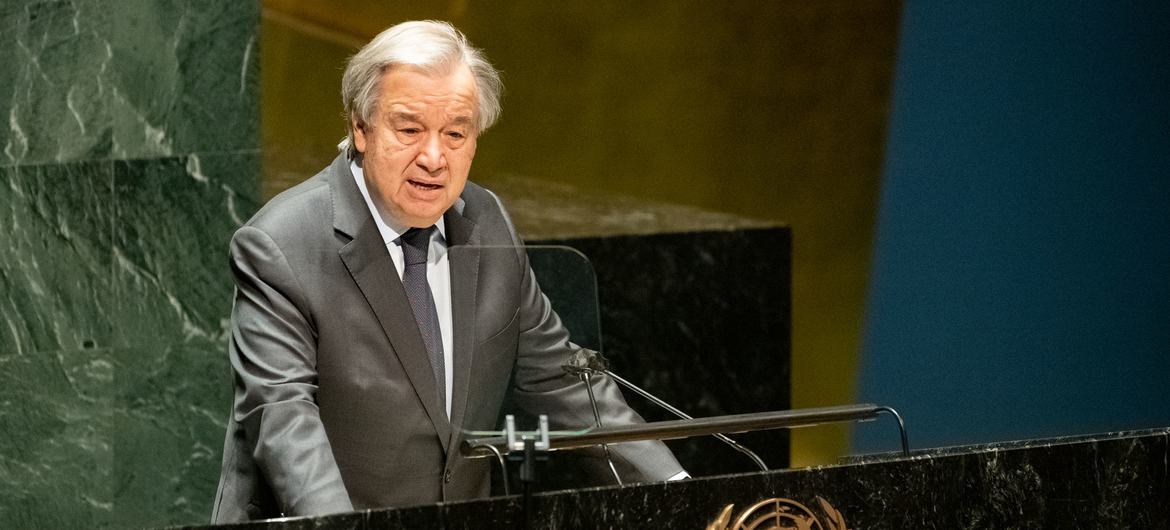
In his address, Secretary-General Guterres said that the fighting in Ukraine must stop.
He said: "Across Ukraine, fighting is raging in the air, on land and at sea. It must stop now."
He said Russian missiles and air bombardment were striking Ukrainian cities day and night. The capital, Kyiv, was surrounded.
The 3 million residents of Kyiv were forced to seek safety in their homes, makeshift bomb shelters and the city's metro.
About 500,000 Ukrainians have fled across the country's borders.
He said: "This escalating violence — which is causing the deaths of civilians, including children — is utterly unacceptable. Enough is enough."
Guterres stressed: "Soldiers need to move back to their barracks. Leaders need to move towards peace. Civilians must be protected. International humanitarian and human rights law must be upheld. The sovereignty, independence and territorial integrity of Ukraine, within its internationally recognized borders, must be respected in line with the resolutions of the General Assembly."
"Nuclear Conflict Is Simply Unthinkable"
Guterres said: "We face the tragedy of Ukraine, but also a major regional crisis with potentially disastrous implications for us all."
He said: "Yesterday, Russia's nuclear forces were placed on high alert. This is a chilling development. The mere idea of a nuclear conflict is simply unthinkable. Nothing can justify the use of nuclear weapons."
The Most Serious Humanitarian and Refugee Crisis in Europe in Decades
Guterres said the current situation could easily turn into Europe's most serious humanitarian and refugee crisis in decades, with the number of refugees and internally displaced persons increasing by the minute.
He said: "In the coming days and weeks, Ukraine's neighbors will need our full support. The United Nations will continue to assist these efforts."
On Saturday, Guterres spoke with Ukrainian President Zelensky, assured him that the United Nations would not abandon the Ukrainian people, and expressed the United Nations' determination to step up humanitarian assistance.
Even before the events of last week, the United Nations had already provided humanitarian assistance to some 3 million people on both sides of the contact line in eastern Ukraine.
The United Nations is now working around the clock to assess humanitarian needs and to scale up life-saving support to more people in urgent need of protection and shelter.
The United Nations Central Emergency Response Fund has already allocated US$20 million for Ukraine. The Secretary-General has also appointed Amin Awad as United Nations Crisis Coordinator for Ukraine. Tomorrow, the United Nations will launch two emergency appeals for donations for Ukraine and the region.
"We Need Peace Now"
Guterres said: "The guns are talking now, but the path of dialogue must always remain open. It is never too late to engage in good-faith negotiations and to resolve all issues peacefully. I hope the direct talks now taking place between the Ukrainian and Russian delegations will produce not only an immediate halt to the fighting, but also a pathway to a diplomatic solution."
He said: "The United Nations looks forward to triumphing over the scourge of war. In cities around the world, people are taking to the streets to demand an end to the war. The people of Ukraine want and need peace. I believe the people of Russia do too. We need peace now."
Statements by the Various Parties
Sergiy Kyslytsya, Permanent Representative of Ukraine to the United Nations, said: "For the first time since the founding of the United Nations, a full-scale war is taking place in the heart of Europe. Everyone in this world knows that Russia, Russia alone, started this invasion, and that Belarus has now facilitated it as well. This war was not provoked. It was chosen by the man now sitting in the bunker. We know how it ended for the man sitting in the Berlin bunker in May 1945."
Vasily Nebenzya, Permanent Representative of Russia to the United Nations, said: "The occupation of Ukraine is not part of our plans. The purpose of this special operation is to protect people who have been subjected to abuse and genocide by the Kyiv regime for eight years. To this end, it is necessary to demilitarize and de-Nazify Ukraine. We will also work to bring to justice those who have committed numerous bloody crimes against civilians, including Russian citizens."
Olof Skoog, Head of the European Union Delegation to the United Nations, said: "In the past, the international community has too often been blind or too slow in the face of unfolding tragedy. Entire generations in many parts of the world have paid, and are still paying, the price for inaction. We cannot make the same mistake again: we must act."
Zhang Jun, Permanent Representative of China to the United Nations, said: "The Cold War ended long ago, and the Cold War mentality based on bloc confrontation should be abandoned; provoking a new Cold War would do nothing but harm. The security of one country cannot come at the expense of the security of others, and regional security cannot be guaranteed by strengthening or even expanding military blocs. China supports the resumption of dialogue among the EU, NATO and Russia, upholding the concept of indivisible security, properly addressing the legitimate security concerns of all parties, including Russia, and seeking to build a balanced, effective and sustainable European security mechanism to achieve lasting peace and stability on the European continent."
Revisiting the Charter of the United Nations
In 1945, as World War II was drawing to a close, representatives of 50 countries gathered in San Francisco to draft and sign the Charter of the United Nations, thereby establishing a new international organization — the United Nations — and bringing rules and hope to a world lying in ruins. Today, let us revisit the principles and values upheld by this "timeless guide" born in wartime, and the inspiration it brings amid the crises of today's world.
Source: Pacific Rim Institute for Development and Education (P.R.I.D.E.)